Raid on the Temple of Tinia
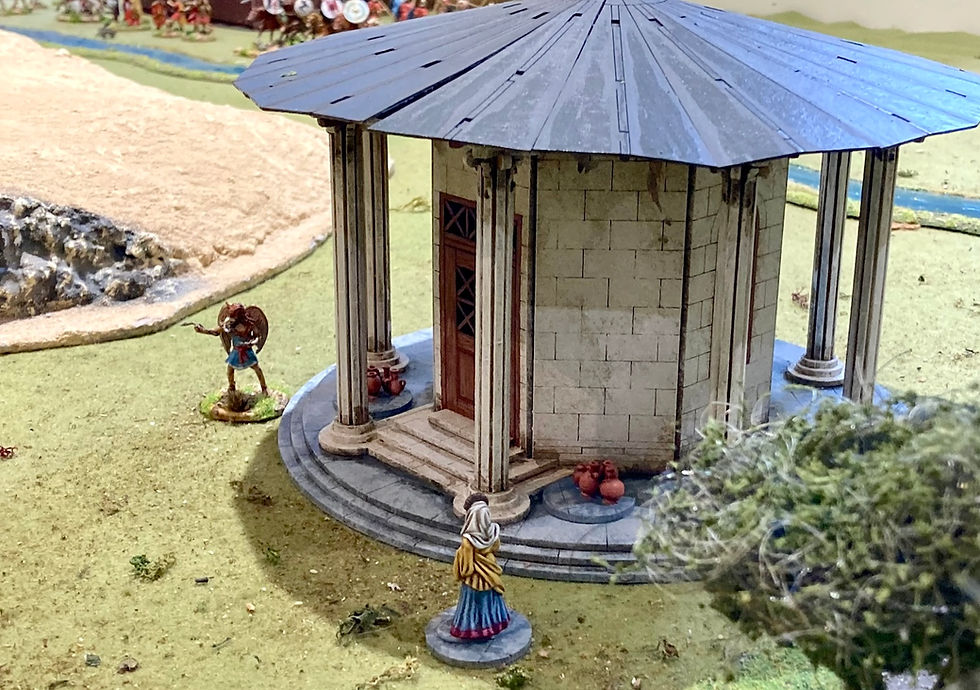
Larth Ulthes, Prince of Tarquinia, has learned of a planned Roman raid on the Sacred Temple of Tinia (Jupiter to the Romans). Larth assembles a force and leads them forth to prevent the sacrilege.

Led by Tribune Marcus Manlius Lupus, the Romans advance quickly over the hills towards the temple.

To protect the Etruscan left, the gallant Velthur Macstarna, leads forward the dashing young aristocratic cavalry of Tarquinia to counter Roman cavalry advancing on that flank.

Moving up, Lucius Manlius’ Roman cavalry are enraged by a hail of stones from some Etruscan slingers. This prods them into launching a fierce ‘bridleless charge’ against the Velthur’s Etruscan horsemen rather than standing around and getting pelted.

When the clash comes, the Roman cavalry live up to their poor reputation. Most men are killed or (being notoriously bad horsemen) perhaps fall off their horses. Lucius Manilus and the few survivors 'lose their amphora' and flee to safety.

In the centre, Prince Larth’s Etruscan Hoplites have formed ‘phalanx’ to meet the Roman advance and to defend the temple.

The Romans hurl their heavy javelins but the Etruscans hold firm, presenting a formidable wall of shields and hedge of spears to the Romans.
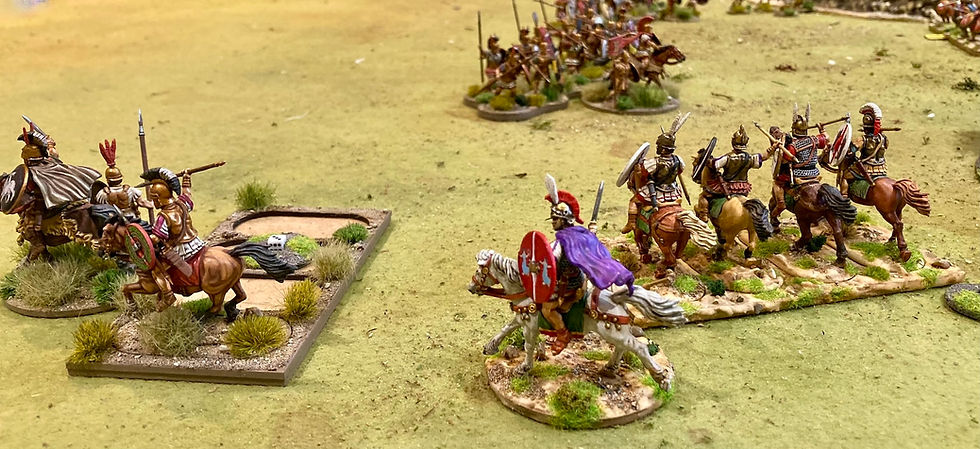
Having chased off the Roman cavalry, Velthur swings his horsemen around to threaten the flank of Tribune Marcus’ Roman hoplites. It is beginning to look like an Etruscan victory is inevitable. Then the hand of fate turns.

The canny Roman Tribune splits off one group of his hoplites to advance on the Etruscan cavalry. Velthur is faced with two unpalatable choices. The sensible option would be to evade but this would almost certainly drive him off-table, probably never to return and leaving the Etruscan left wide open. The brave option would be to stand and fight, knowing that his chance of success would be slim in the extreme but it could at least hold the flank for a while. The gallant Etruscan cavalry, of course, stand to fight it out knowing that many will die on the spears of the elite Roman hoplites.

The combat is fierce and the Etruscans give as good as they receive in the initial clash. In succeeding rounds they are worn down by weight of numbers and eventually break.

Meanwhile on the other flank, Quintus Licinius’ Roman antepilani let lose a volley of javelins and charge the Etruscan 3rd & 4th Class mercenaries and levy. Although the numbers are relatively even the Etruscans are sent reeling back.

A further push by Quintus’ men breaks the Etruscan right and the Romans are now in a position to get behind the Etruscan hoplites in the centre.

With Roman hoplites also making their way around the Etruscan left, Prince Larth realises his yet-unengaged indomitable hoplites have been doubly enveloped. He has no option other than to order a withdrawal and leave the temple to Roman depredations.

This was an exciting test game for Andy Hawes’ Dux Italica rules — an adaptation of Dux Britanniarum for games set at the time of the Roman conquest of Italy (4th Century BC). The rules worked really well with only a few minor tweaks needed. Although the the core Dux Brit rules remained unaltered there were enough period-specific changes to really feel like an engagement in 4th C BC Italy. I look forward to our next game and also to painting up a contingent of Gauls which is waiting


It looks like an excellent game. As I have said elsewhere the models are superb 👌 well done Andy and Simon 👏