Constantinople Revisited
I have just returned from a brief trip to Constantinople (aka Istanbul) mainly re-visiting some of my favourite historical sights and adding a few new ones.

Theodosius’ Obelisk (AD 390) stands in the middle of the Hippodrome.

At its base is a frieze of the Emperor and Empress watching a chariot race surrounded by Roman notables and flanked by guardsmen. The guards are certainly Germans judging by their neck torques, long hair and clean shaven faces as opposed to the bearded, short-haired Romans (this being Roman fashion in the 4th to 5th centuries at a time when most Germans were beardless).
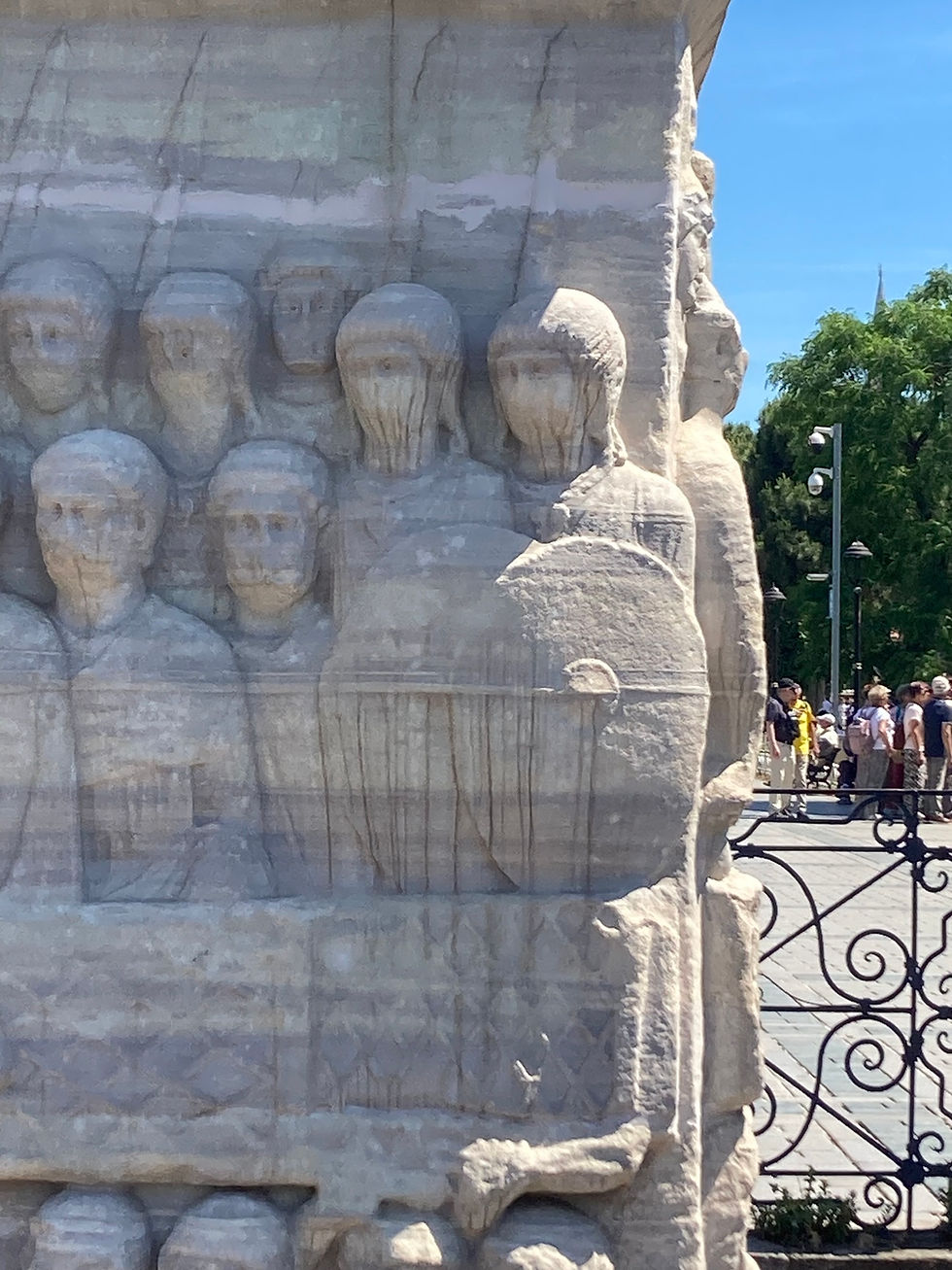
The most interesting feature of the soldiers is their shields. A cursory glance suggests that they are standard late Roman ovals. My partner Caroline seeing them for the first time with her keen artistic eye, pointed out that the bosses are off-set nearer the top, and the bottom of the shields taper slightly. Could these be forerunners of the early medieval kite shields? It is generally believed that kite shaped shields originated in the East Roman Empire and were adopted and adapted by Normans and other Westerners. The offset boss and tapering bottom make lots of sense for men who fight on horseback.

The exterior of Justinian’s magnificent Hagia Sophia (now nearly 1500 years old) was unfortunately covered with scaffolding but the inside is still spectacular. The early mosaics were destroyed in the 8th- 9th Century Iconoclastic period but some later additions are still very well preserved. The photo above shows the Emperor John Komnenos (AD 1118 -1143) and the Empress Eirene.

The Emperors Constantine (right) and Justinian (left) respectively presenting models of Constantinople and the Hagia Sophia to Mary and Jesus.

A marble wall and door marks the entrance to the Imperial balcony.

Beyond the door there is some 9th/10th Century Norse graffiti carved into the marble at the top of the balcony balustrade. Apparently the runes read something like "Halvdan was here”. Presumably this was done by a Varangian guardsman on a late night shift with sufficient time and solitude to leave his name to history.

Much of the famous walls of Constantinople still stand. Some crumbling and some reconstructed.

The 13th century Palace of the Porphyrogenitus (Tekfur Sarayı) still stands In the Blachernae district of Constantinople (now Ayvansaray). Apart from the Hagia Sophia it is one of the very few remaining intact East Roman buildings in Istanbul. It is tucked into the city walls in the northeastern part of the original Roman city. This was the main residence of the Komnenian Emperors.

Before leaving I paid a visit to the Istanbul Archaeological Museum which houses the magnificent Alexander Sarcophagus— so call because of its depiction of the Battle of Issus (333 BC). It was most probably the tomb of Abdalonymos the Phoenician who was appointed King of Sidon by Alexander.

The Macedonian infantryman depicted here on the sarcophagus has resulted in endless and still inconclusive debates about the armament of Alexander’s Hypaspists. He has a hoplite shield and is using a spear over-arm. Literary sources suggest they were more lightly equipped. The hole on the side of his helmet may have originally housed a feather plume.

This top panel is thought to depict the Battle of Gaza (312 BC) between Seleucus and Ptolemy in or after which Abdalonymos met his death


Fascinating. Thank you for posting.